
An island unlike
anywhere else.
Welcome to Nauru, an intriguing remote Pacific republic, ancient coral limestone pinnacles, freshwater lagoons, and authentic Micronesian heritage.
Remote, authentic, and genuinely worth discovering.
Situated just 42 kilometers south of the Equator, Nauru is one of the world’s most singular island democracies. Beyond its compact geographic footprint lies a realm of dramatic visual contrasts: ancient coral limestone pinnacles standing across the central plateau, crystal ocean drop-offs teeming with pelagic fish, and peaceful freshwater lagoons enclosed by tropical palms.
“Arriving in Nauru feels like discovering a quiet world unchanged by mass tourism.”


Fly direct to Nauru International Airport
Nauru Airlines connects Yaren (INU) with Brisbane (Australia), Nadi (Fiji), Suva (Fiji), Tarawa (Kiribati), Majuro (Marshall Islands), and Honiara (Solomon Islands).
Pacific Flight Network
D3.js · Natural Earth 110m · Great-circle arcs · Click any city
Nauru (INU) ✈ Brisbane (BNE)
Australia · 4h 30m flight
Places to discover

Anibare Bay
Nauru's most beautiful white-sand bay on the east coast.

Buada Lagoon
A serene freshwater lagoon in the island's green interior.
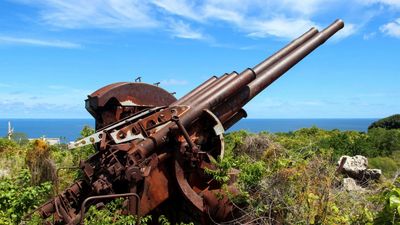
Command Ridge
The island's highest point, crowned with WWII relics.
Things to do in Nauru
Reef Snorkelling at Anibare
Explore the coral shelf just off Anibare Bay.
Island Loop Drive
Circle the whole island on its 19km coastal road.
Topside Pinnacle Walk
Walk among the coral pinnacles of the central plateau.
Stories from Nauru

One Perfect Day in Nauru
From sunrise at Anibare Bay to WWII history on Command Ridge, here is how to make the most of a single day on Nauru.
Understanding Topside
Nauru's interior plateau tells a complex story of resource, change and rehabilitation.
Living Nauruan Heritage & Words
Nauruan is an indigenous Micronesian language spoken across the 14 districts. Here are a few traditional phrases visitors may hear:
Traditional warm island greeting.
The coastal coral reef waters.
Celebration of population resilience.
Where to stay in Nauru

Fly direct to Nauru International Airport
Nauru Airlines connects Yaren (INU) with Brisbane (Australia), Nadi (Fiji), Suva (Fiji), Tarawa (Kiribati), Majuro (Marshall Islands), and Honiara (Solomon Islands).
Travel Responsibly in Nauru
Protect marine coral ecosystems, respect local island traditions, support Nauruan family businesses, and leave no trace.
Nauru Travel FAQ
Everything you need to know before visiting Nauru — visas, flights, currency, climate, safety, and key practical information for first-time visitors.
Yes — nearly all foreign visitors require an approved visa prior to entering the Republic of Nauru. You must apply for and obtain entry approval from the Nauru Department of Foreign Affairs & Immigration before boarding your flight. Passport holders from a limited list of South Pacific partner countries may be eligible for visa on arrival or visa-free entry, but all other international tourists must submit a formal visa application in advance. Verify current rules and download official application forms at the Government of Nauru Visa Portal.
Nauru International Airport (IATA: INU) in Yaren is the sole airport on the island. Nauru Airlines (ON) is the only commercial airline serving Nauru, operating scheduled flights from Brisbane, Australia (BNE), Nadi, Fiji (NAN), Suva, Fiji (SUV), Tarawa, Kiribati (TRW), Majuro, Marshall Islands (MAJ), and Honiara, Solomon Islands (HIR). Travelers from Europe, Asia, or the Americas connect via Brisbane or Fiji.
The Australian Dollar (AUD) is the official legal tender in Nauru. Bendigo Bank operates a branch and ATM service in Yaren District. Credit card acceptance is extremely limited across the island (primarily available at Menen Hotel and select establishments), so visitors must bring adequate AUD cash for daily expenses, dining, and local purchases.
Nauru is a very safe destination with minimal violent crime. Visitors should exercise standard travel precautions: protect personal belongings, respect local culture and Sunday religious observances, and note that hospital facilities on island are basic. Comprehensive international travel insurance with emergency medical evacuation cover is required for all visitors.
Nauru experiences a warm tropical climate year-round with average temperatures between 26–32°C. The dry season (April to October) offers pleasant sea breezes, lower humidity, and ideal ocean visibility for snorkelling at Anibare Bay. The wet season (November to March) brings tropical showers, though the island remains warm and fully accessible year-round.
Top attractions include: Anibare Bay (white sand beach framed by coral pinnacles); Buada Lagoon (tranquil freshwater lake surrounded by palms); Command Ridge (island's highest peak with WWII Japanese command bunker & artillery); Topside Coral Pinnacles (surreal limestone landscape); ocean drop-off reef snorkelling; Nauru Phosphate Museum; and experiencing Angam Day cultural celebrations (October 26).
Nauruan (Dorerin Naoero) is the native Micronesian language spoken by the Nauruan people across all 14 districts. English is widely spoken in business, government, hotels, and tourism contexts. Essential Nauruan greetings: 'Ekamoweni' (Welcome / Hello), 'Tubwa eko' (Thank you), 'Anin' (Yes), 'Aibuobuo' (No).
All arriving passengers must present: (1) a valid passport with at least 6 months validity remaining beyond intended departure; (2) an approved Nauru visitor visa or entry permit; (3) a confirmed return or onward flight ticket; and (4) proof of accommodation booking in Nauru.
Nauru has a unique history as a raised coral atoll settled over 3,000 years ago. It was colonised by Germany in 1888, occupied by Japan during WWII (1942–1945), and administered by Australia until gaining independence on January 31, 1968. Nauru became famous in the 20th century for its rich natural phosphate reserves.
Digicel Nauru provides 3G/4G mobile network coverage across the entire island. Tourist SIM cards can be purchased upon arrival. Wi-Fi is available at Menen Hotel, OD-N-Aiwo Hotel, and major accommodation providers.
Official & Authoritative Links
Always verify visa and entry requirements directly with official Nauru government sources before travelling.